

Search our site…
Safeguarding Adults Framework
The Safeguarding Adults Framework has been developed by multi-agency partners of the Suffolk Safeguarding Partnership in consultation with a number of organisations across Suffolk.
It's a handy tool that aims to assist practitioners and their organisations with a common understanding of indicators of abuse. It will help identify the abuse type and what, if any, interventions are required (such as reporting a safeguarding concern), and can be used at any time.
E-learning
To help you get to grips with the Framework and how to use it, we’ve developed a short, informative e-learning module open to all organisations which guides you through the Framework, giving practical examples of how to apply it. The link the course is: https://www.suffolkcpd.co.uk/app/learner/resources/13962
Suffolk’s Continuum of Need
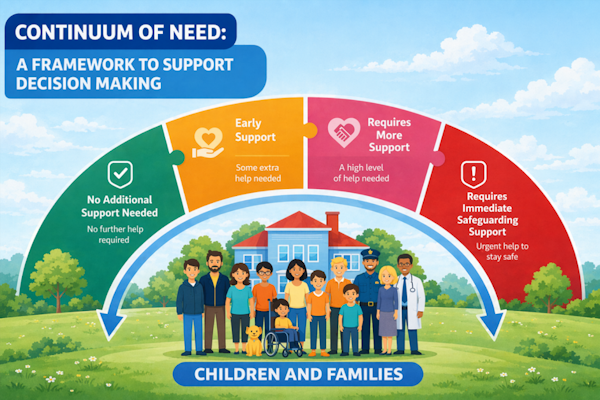
The Suffolk Continuum of Need supports practitioners to understand the needs of children, young people and their families and to identify the most appropriate response. It provides a shared multi-agency framework for considering the child’s lived experience, the family’s strengths, the presence of harm or risk, and the support needed to improve outcomes.
Children and families’ circumstances are individual and can change over time. The levels within the Continuum of Need should therefore not be treated as rigid thresholds or as a linear pathway that families must move through before receiving support. Children may move between levels of need, and some will require an immediate response at a higher level.
Practitioners should use professional judgement, informed by:
the child or young person’s lived experience and wishes;
the views and experiences of parents, carers and the wider family network;
the impact of needs, harm or risk on the child;
family strengths, safety and protective factors;
the pattern, duration and cumulative impact of concerns;
previous support and whether it has led to sustained change;
relevant statutory duties and guidance; and
information shared by partner agencies.
The Continuum of Need should support professional analysis rather than replace it. Decisions should be made collaboratively with children and families wherever possible, using the Suffolk Signs of Safety and Wellbeing approach (SOS+) to explore what is working well, what we are worried about, existing safety, and what needs to happen next. Practitioners should also apply a Think Family approach and use the Assessment Triangle to understand the child's lived experience within the context of their developmental needs, parenting experiences, family relationships and wider environment. Together, these approaches support a holistic understanding of the child and help inform proportionate, child-centred decision-making.
Levels of Need
There are Four Levels of Need as agreed by partners of the Suffolk Safeguarding Partnership.
Level 1: No Additional Support Needed
Children and families whose needs are being met through family and community networks and universal services, such as health, education and community provision.
Level 2: Early Support
Some children and families benefit from additional help when needs first emerge. Early Support is a coordinated response involving services that already know the child and family.
Examples include support from:
Schools and early years settings
Family and Youth Hubs
Health professionals
Community and voluntary organisations
Community Connectors
Level 3: Requires More Support
Children with more complex or escalating needs may require support through Family Help. A Family Help Practitioner works alongside the family and wider network to coordinate support and develop a Family and Friends-led plan. This may include statutory assessment and support under section 17 of the Children Act 1989 where the child is assessed as being in need.
Level 4: Requires Immediately Safeguarding Support
Children who may be at risk of, or experiencing, significant harm and require an immediate, coordinated safeguarding response. This may include child protection enquiries and other specialist statutory intervention.
Right Help at The Right Time
Children and young people should receive the right help at the right time, without unnecessary delays or being passed between services. When a child or family needs support, practitioners should work together to understand the child’s lived experience, respond to their immediate needs, and ensure any transition to another service is planned, coordinated and centred on what is best for the child.